

Can the way we keep time change the way we live?
"The Use of Saints' Days"
“It cannot be that things should stand still thus.
Christ's Church is indestructible;
and, lasting on through all the vicissitudes of this world,
she must rise again and flourish,
when the poor creatures of a day who opposed Her,
have crumbled into dust.”
-St. John Henry Newman
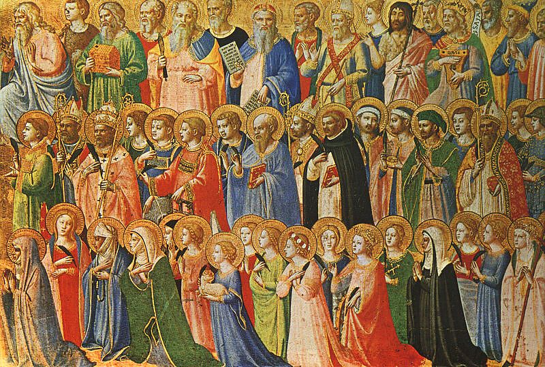
Fra Angelico, The Forerunners of Christ with Saints and Martyrs, 1420s.
National Gallery, London. Image source: Wikimedia
Heart Speaks to Heart – Cor ad Cor Loquitur
Sermon Reflection 12 for November 2026
by Sister Mary Catherine Blanding, IHM
https://www.newmanreader.org/works/parochial/volume2/sermon32.html
Useful Vocabulary
Ritual: the Church’s ordered worship and observances
Salutary: (as used in the sermon) beneficial or health-giving—something that is good for a person’s spiritual well-being (from the Latin, salus, “health”)
Indestructible: “not able to be destroyed.” In Newman’s sentence, it is a forceful way of saying that Christ’s Church will not be wiped out or brought to an end by the hostility, indifference, or neglect of people.
Reading Helps
As you read the sermon, the following questions can guide you or help you understand St. John Henry’s points.
Page references correspond to the edition used by our group.
393 — St. John Henry Newman’s Contemplative Spirit towards Saints
How does Newman’s description of the saints challenge or deepen your own appreciation of them?
395 — The History of the Feast
Newman’s 1834 sermon reflects on All Saints’ Day rather than tracing its full history. Christians commemorated martyrs from the early centuries, and common feasts developed over time. Pope Boniface IV’s dedication of the Pantheon to all the saints is associated with a May 13 observance; Pope Gregory IV is traditionally credited with extending the November 1 feast, though its development remains uncertain. https://www.catholic.com/tract/all-saints-day-catholic-answers-guide
396 — Religious Observance and Sin
What does Newman identify as the spiritual failings of nineteenth-century society?
396–397 — Christian Year vs. Secular Year
How does the Christian calendar differ from the secular calendar in shaping our lives?
“397–398 — Spiritual Famine”
What led to the spiritual famine Newman observed in the Anglican Church in 1834?
398 — The Importance of Gathering
Why are assemblies important to human society, and why is gathering for worship especially important?
398–399 — The Witness of a Gathered Church
How can the public gathering of the faithful on holy days bear witness to the faith more powerfully than words alone?
399 — Blessings from Holy Days
What spiritual benefits come from observing saints’ days and other holy days?
400–402 — Healthy Humility and the Church’s Indestructibility
How do Newman’s reflections on the Church’s indestructibility and our own sinfulness challenge self-conceit and judgment of others?
Points to Ponder
- Art and the Saints
How do beauty and the witness of the saints make the faith credible and draw others toward Christ?
(Pope Benedict XVI has spoken of the importance of art and the saints in making the faith credible. See his address to the Pontifical Council for Culture.) - Secular Commemorative Days
What distinguishes a liturgical feast from a secular observance? What do the occasions a society chooses to commemorate reveal about its understanding of the human person and the good life? - Busyness and Sloth
When does busyness become a form of spiritual sloth? Newman challenges a utilitarian mindset that can reduce life to usefulness and achievement. What might he say to our society today? - Conscience, Time, and Eternity
How can we recover Newman’s vision of a society in which daily life and business are ordered by Christian faith? - Remembering Our Eternal Destiny
Why do people sometimes resent reminders of mortality, and how do the Church’s liturgical observances help us remember our eternal destiny? - The Church as a Place of Prayer
How does access to churches for quiet prayer provide daily spiritual sustenance - The Saints as Patterns of Excellence
What saints influence you or what saints do you want to know better? - Suffering
How does Newman distinguish suffering borne through fidelity to Christ from suffering caused by our own faults or unnecessarily sought?
Personal Reflection Questions
- Is becoming a saint a central desire of my life?
- In an age of social slander, do I guard against rash judgment?
- As my vocation and circumstances permit, does my life keep pace with the liturgy?
- When I judge the actions of Church or public leaders, do I remember my own need for grace and the responsibilities that accompany the blessings I have received?
- How can I practice Newman’s counsel to say little and do much while avoiding both self-righteousness and cowardice?
Immaculate Heart of Mary, pray for us. St. John Henry Newman, pray for us. All saints, pray for us.
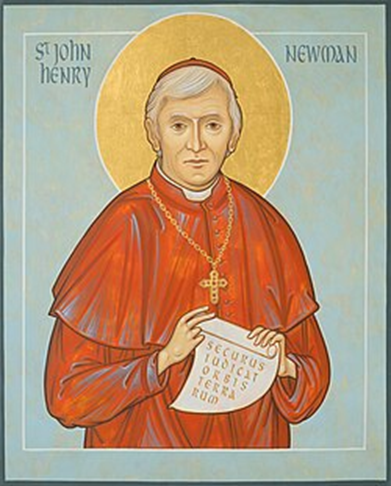
Source: https://en.wikipedia.org/wiki/Canonisation_of_John_Henry_Newman