

Lent doesn’t end at Easter—it reaches its fullness. Forty days of tears open to Easter joy
"Keeping Fast and Festival"
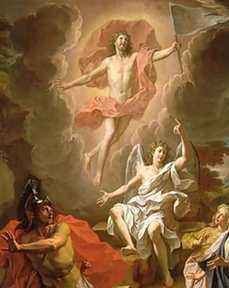
Resurrection of Christ, Noël Coypel, 1700
Heart Speaks to Heart – Cor ad Cor Loquitur
Sermon Reflection 9 for April 2026
by Sister Mary Catherine Blanding, IHM
https://www.newmanreader.org/works/parochial/volume4/sermon23.html
“His infinite influence with the Father is ours…so fully ours, that when we ask and do things according to His will, we are really possessed of a power with God, and do prevail.”
St. John Henry Newman, “Keeping Fast and Festival” note 342
Sermon Synopsis
On Easter Sunday, 1838, St. John Henry Newman preached on how to rightly live the fifty days of Easter. Feasting sounds simple—but it requires discipline. Without guidance, it can slip into excess, distraction, or spiritual dullness. In this sermon, St. John Henry shows that Easter joy must be entered into with reverence, restraint, and interior depth.
Reading Helps
(The numbers correspond to the sermon’s paragraph or note numbers in the text.)
- 334–335 – The distinction between Christmas joy and Easter joy
- 336 – The experience of Holy Week as a “dream” within Eastertide
- 337 – The difficulty of fully entering into Easter joy
- 338 – Christian conduct in trial as a sign of faith and love
- 339 – The distinction between Christian mirth and non-Christian pleasure
- 340 – The structure of Lent as forty days and Eastertide as fifty days
- 341 – The meaning of the Blessed Virgin’s silence
- 342 – The blessings given through the Resurrection
- 343 – The apostolic call to action and spiritual vigilance
Points to Ponder
- Why do we need guidance in Christian feasting?
- How does the transition from Lent to Easter reveal a kind of spiritual “sickness,” and what does St. John Henry mean by this image?
- Why does Easter joy depend on having first entered into Lenten sorrow?
- In what way is Lent meant to function as a means of grace in the Christian life?
- How does temperance allow us to enjoy created goods without being mastered by them?
- What does St. John Henry mean by describing Easter joy as “holy, tender, reverent, manly joy”?
- What does his portrayal of the Blessed Virgin reveal about silence, faith, and interior depth?
- How does Lenten discipline continue—rather than disappear—within Easter joy?
Personal Reflection
† 1. How do I examine my heart during seasons of celebration, not only in seasons of fasting?
† 2. In what ways do I allow the words of St. John Henry Newman to deepen my trust in God’s providence?
† 3. Do I recognize that I am continually given access to grace, even in ordinary moments of life?
† 4. How intentionally do I participate in the spiritual realities represented by the Holy Name, the Sign of the Cross, the Precious Blood?
† 5. Where in my daily life am I being invited to make these practices more deliberate, real, and prayerful?
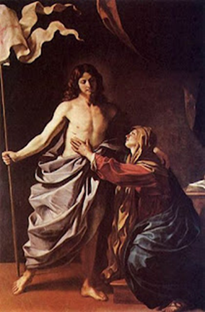 Guercino, Apparition of Christ to the Virgin, 1628-1630
Prayer
Risen Christ, have mercy on us!
Our Lady, pray for us.
St. John Henry Newman, pray for us.
Sources
David Warren – Keeping Fast and Festival
Stephanie Mann – Keeping Fast and Festival