

"Self-Denial, the Test of Religious Earnestness"
"Self-Denial, the Test of Religious Earnestness"
Heart Speaks to Heart – Cor ad Cor Loquitur
Sermon Reflection 8 for March 2026
by Sister Mary Catherine Blanding, IHM
https://www.newmanreader.org/works/parochial/volume1/sermon5.html
Aids to Reading the Sermon
The numbers refer to the note numbers in the sermon.
58 He defines sleep: a state of insensibility to things as they really are in God's sight… a lack of awareness of God's reality.
58 St. JHN continues the metaphor of being asleep to God's reality, showing how God is trying to disclose His world to us—most hit the snooze button and continue to sleep, unaware of the glories surrounding them if they wake.
59 St. John Henry does not state that his congregation is in a state of serious sin, but that they are still sleepy. He urges them to ask the question, “How do I know that I have real faith?”
59 He continues that since Victorian England professes to be Christian, there is more danger of lukewarmness.
60 Great blessings, such as the practice of our faith, can be a serious temptation, Newman warns. It may not be the real Gospel we are promoting.
61 Though we are thankful for those who profess faith, if they do not change in their manner of speech—or, even worse, act with the world in its evil ways and remain lax in morality—there is a gross inconsistency.
62 St. JHN expresses concern that a popular religion may be a counterfeit or a “dream.”
63 If you are in a group that prizes the faith and acting virtuously, you may be faced with two dangers: (1) doing right from wanting to be accepted by others; (2) being cheated of the truth by praise.
64 When we are in religious circles, we must be more careful of self-complacency, but when we live in an anti-Christian culture, there is more hope, since this would inevitably bring some kind of persecution.
65–66 If we practice self-denial, this gives us proof that we are following Christ, even if we are in a non-persecuted society.
67 The test of our self-denial: consistency, daily. In our newest doctor’s words: “It consists in the continual practice of small duties which are distasteful to us.”
68 Our trial is not in what is easy to us, but in our predominant fault. (This fault differs according to our temperament and upbringing.)
69 St. JHN tells us that our predominant fault, if not daily weeded out, will influence everything: our judgment of other people, events, teachings, and even our faith in the Gospel. He urges us to put upon ourselves other kinds of self-denial if we are not tempted in our usual sin, in order to build up self-control, always relying upon God.
71 He warns us to avoid pretty speech about the Gospel and to put everything we say into action.
Questions to Ponder
- (58) Comment on the analogy of sleep. Is this a helpful allusion? Compare/contrast to Plato’s metaphor of the cave. Why the insistent refusal to awake from slumber?
- Comment on the “means” God uses to enlighten us versus private judgment.
- (59–60) Are we in the 21st century in a world of persecution or in a world of lukewarm Christianity? Or both?
- (61) Note our Saint uses the phrase “religion of the day.” Again, how is this term applicable to us in the 21st century? Is it more pronounced or less pronounced than in the Victorian Age, and how?
- (61) Apply to today: “Satan transformed into an angel of light.” Exemplify how this may be in our culture.
Ron Snyder, in his podcast, brought out The Lord of the World by Benson; this sense of an Angel of Light can be seen in the contemporary novel Father Elijah by Michael O’Brien. Your thoughts? - (61) Why is Newman fearful of a “religion of the people”? Is he being consistent with God’s will?
- (64) Why is being in a persecuted country a cause for joy, according to Newman? Agree/disagree?
- (65–66) Our crosses and our penances bring definitive solace. This seems to be an oxymoron, but it is not. Why?
- (68) Evaluate: “Now let everyone consider what his weak point is; in that is his trial.” Is this true? What about being fed to the lions or being burned at the stake? Is this “weak point” and struggling against it a real trial? Your comments?
- (69) Why does he say our one fault can influence everything we think and how we act, if we are not careful to deny ourselves in our weakness?
- One writer coined the phrase “original excuse”… everyone has a reason for his sin. How is this theme contained in Newman’s sermons? Do you agree or disagree?
Personal Reflection Questions
- What is your predominant fault? Can you realistically nail it down and specify it?
- How can you work to overcome it? What are the consequences of not working on this fault?
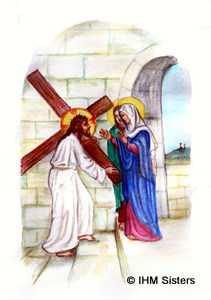
- How is struggle with our predominant fault the real taking of the cross in our lives?
May you have a transforming Easter!